Can We Fight Agains the Goverment With Out Guns
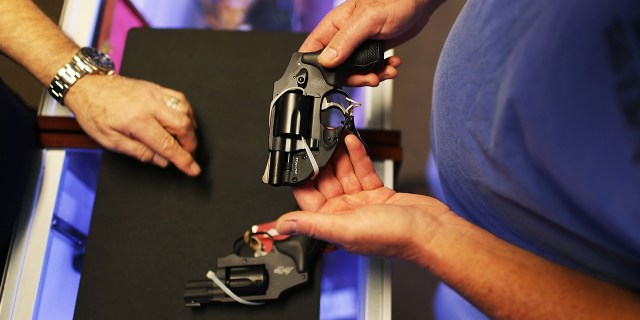
Guns are deeply ingrained in American guild and the nation's political debates.
The Second Subpoena to the U.S. Constitution gives Americans the right to bear arms, and about a third of U.S. adults say they personally own a gun. At the same time, President Joe Biden and other policymakers earlier this year proposed new restrictions on firearm access in an effort to accost gun violence ranging from rising murder rates in some major cities to mass shootings.
Here are some primal findings virtually Americans' attitudes virtually gun violence, gun policy and other subjects, drawn from recent surveys past Pew Research Center and Gallup.
In the aftermath of several contempo mass shootings in the United States, Pew Enquiry Center conducted this assay to share central facts most Americans and guns. We used data from our own polling and from Gallup surveys to provide insights into Americans' views on gun policy and how those views take inverse over time, as well as to examine the proportion of adults who ain guns themselves and their reasons for doing so. Information about the number of monthly gun background checks comes from the FBI's National Instant Criminal Background Check System.
Methodology for each Pew Research Eye poll can be found at the links in the post. Everyone who took part in the surveys is a member of the Center'south American Trends Console (ATP), an online survey console that is recruited through national, random sampling of residential addresses. This way almost all U.Due south. adults have a chance of selection. The survey is weighted to be representative of the U.S. adult population past gender, race, ethnicity, partisan amalgamation, education and other categories. Read more virtually the ATP'southward methodology.
Four-in-x U.S. adults say they live in a household with a gun, including 30% who say they personally own ane, according to a Pew Enquiry Center survey conducted in June 2021.
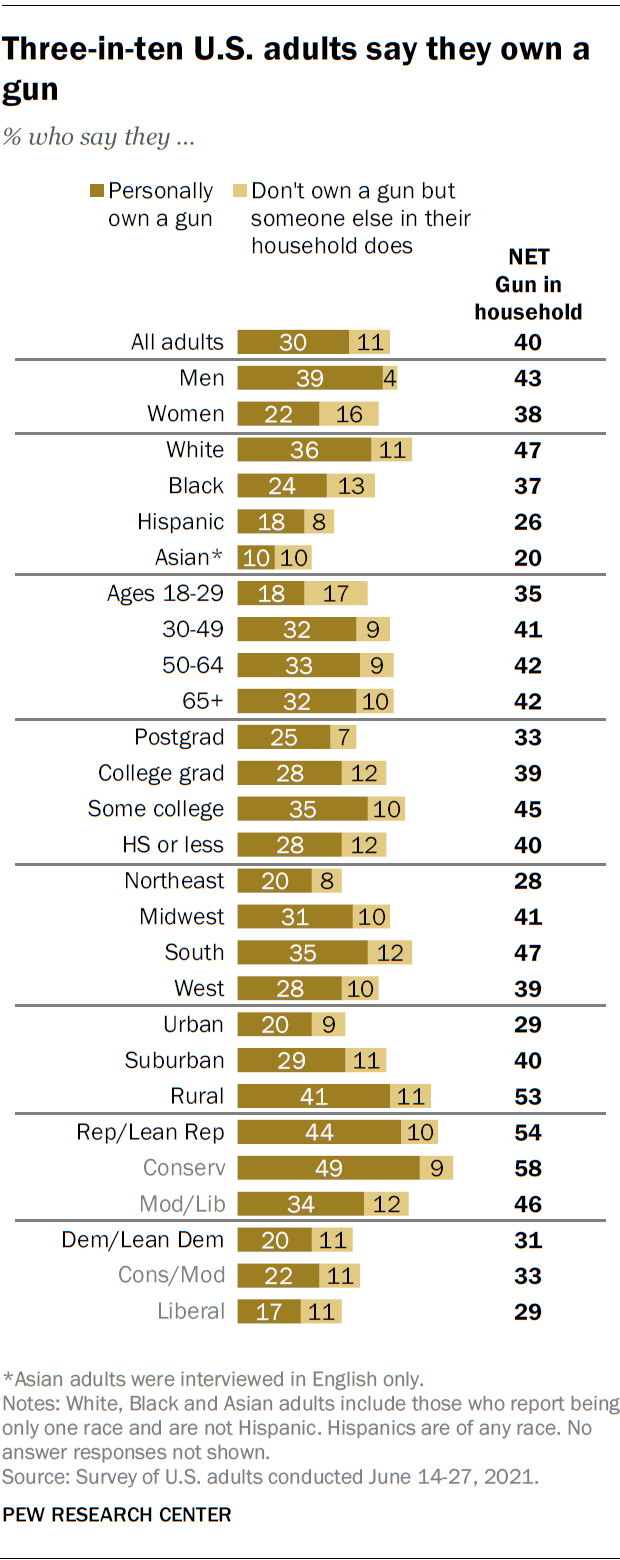
There are differences in gun buying rates past political party affiliation, gender, geography and other factors. For instance, 44% of Republicans and Republican-leaning independents say they personally own a gun, compared with 20% of Democrats and Democratic leaners.
Men are more likely than women to say they own a gun (39% vs. 22%). And 41% of adults living in rural areas report owning a firearm, compared with about 29% of those living in the suburbs and 2-in-ten living in cities.
Federal information suggests that gun sales have risen in recent years, particularly during the coronavirus pandemic. In 2020, the number of monthly federal background checks for gun purchases was consistently at least twenty% higher than in the same month in 2019, according to the FBI's National Instant Criminal Groundwork Check Organization. The largest comparative percentage betoken difference occurred in July 2022 – when almost iii.vi million background checks were completed, 44% more than were conducted in July 2019.
Personal protection tops the list of reasons why gun owners say they ain a firearm. In a Gallup survey conducted in August 2019, gun owners were most probable to cite personal safety or protection equally the reason they own a firearm. Roughly 6-in-ten (63%) said this in an open-ended question. Considerably smaller shares gave other reasons, including hunting (xl%), nonspecific recreation or sport (eleven%), that their gun was an antique or a family heirloom (six%) or that the gun was related to their line of work (five%).
A Pew Research Center survey conducted in 2022 constitute like patterns in firearm owners' stated reasons for owning a gun.
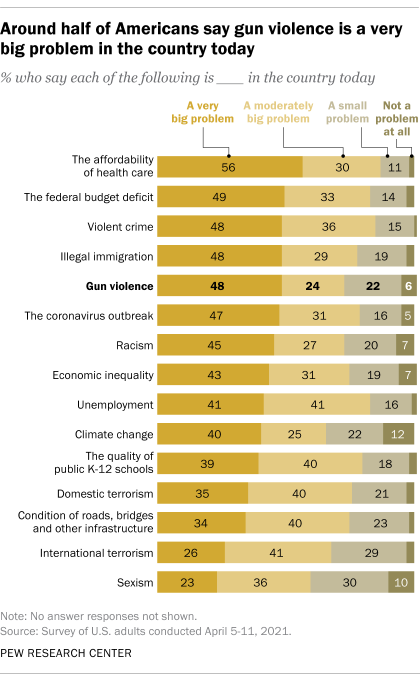
Around half of Americans (48%) run into gun violence as a very big problem in the land today, according to a Pew Research Eye survey conducted in April 2021. That's comparable to the share who say the same about the federal budget deficit (49%), fierce crime (48%), illegal immigration (48%) and the coronavirus outbreak (47%). But one issue is viewed every bit a very big trouble by a majority of Americans: the affordability of health intendance (56%).
Another 24% of adults say gun violence is a moderately big problem. About 3-in-ten say it is either a pocket-size problem (22%) or not a problem at all (6%).
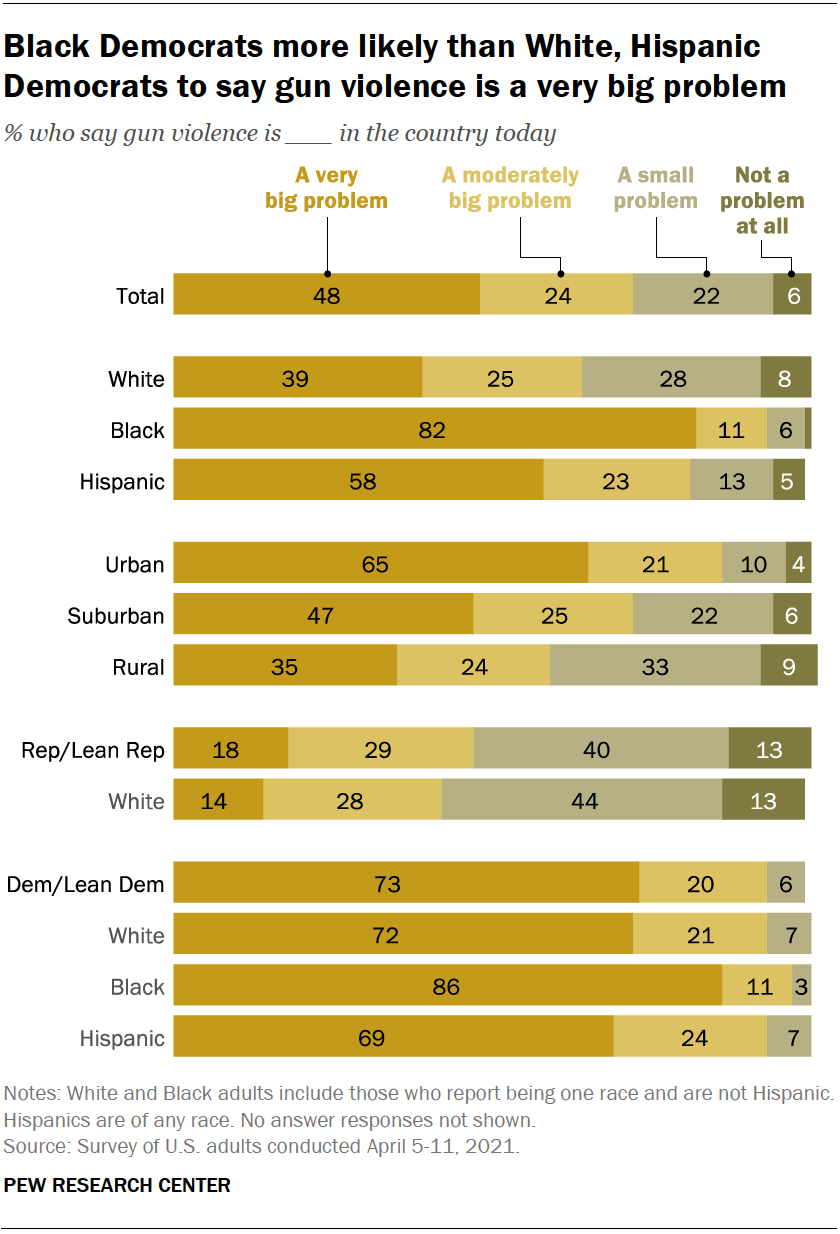
Attitudes about gun violence differ widely by race, ethnicity, party and customs type. About eight-in-x Black adults (82%) say gun violence is a very large problem – by far the largest share of whatever racial or ethnic group. By comparison, about vi-in-ten Hispanic adults (58%) and 39% of White adults view gun violence this way. (Due to sample size limitations, information for Asian Americans is not available.)
Democrats and Democratic-leaning independents are far more probable than Republicans and GOP leaners to see gun violence equally a major problem (73% vs. eighteen%). And nearly two-thirds of Americans who describe their customs as urban (65%) say the same, compared with 47% of suburbanites and 35% of those who alive in rural areas.
Roughly half of Americans (53%) favor stricter gun laws, a turn down since 2019, according to the Center'southward April 2022 survey. Smaller shares say these laws are about right (32%) or should be less strict (14%). The share of Americans who say gun laws should be stricter has decreased from 60% in September 2019. Current opinions are in line with what they were in March 2017.
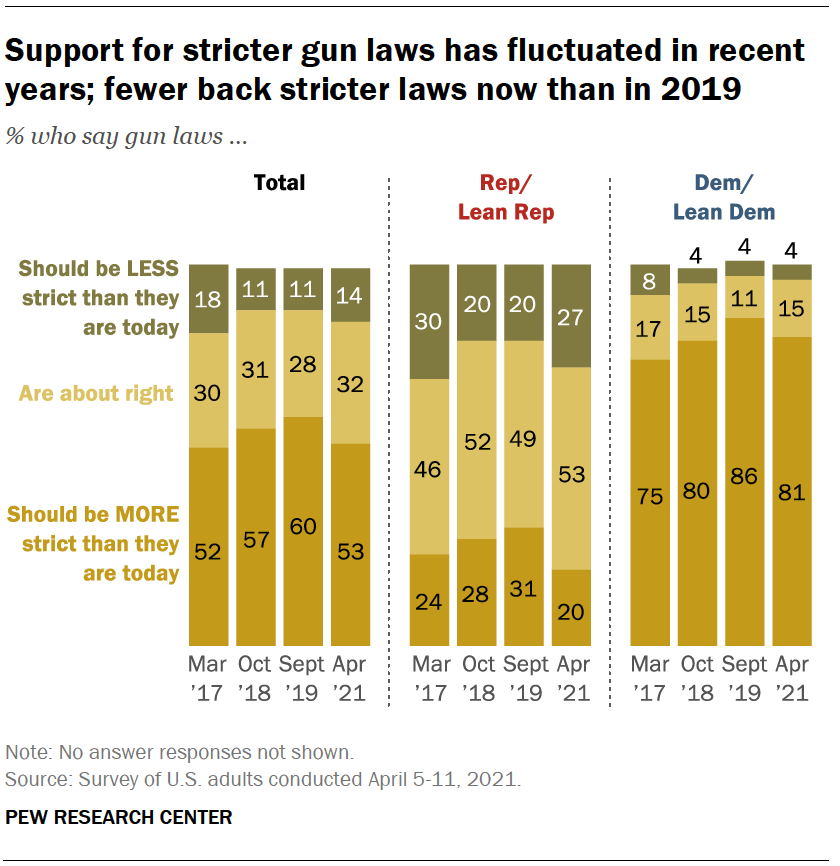
Among Republicans and Republican-leaning independents, views accept shifted. Republicans are currently more probable to say gun laws should exist less strict (27%) than stricter (20%). In 2019, by comparing, a larger share of Republicans favored stricter gun laws than less strict laws (31% vs. 20%). Both years, roughly half of Republicans said current gun laws were virtually right.
Today, a big bulk of Democrats and Autonomous leaners (81%) say gun laws should be stricter, though this share has declined slightly since 2022 (down from 86%).
Americans are divided over whether restricting legal gun buying would atomic number 82 to fewer mass shootings. Debates over the nation's gun laws have often followed recent mass shootings. But Americans are split over whether legal changes would pb to fewer mass shootings, according to the same spring 2022 poll. About half of adults (49%) say there would exist fewer mass shootings if it was harder for people to obtain guns legally, while about as many either say this would make no divergence (42%) or that there would exist more mass shootings (nine%).
The public is fifty-fifty more divided virtually the effects of gun buying on criminal offense overall. Effectually a tertiary (34%) say that if more people owned guns, there would exist more crime. The same percent (34%) say there would be no departure in crime, while 31% say there would exist less criminal offence.
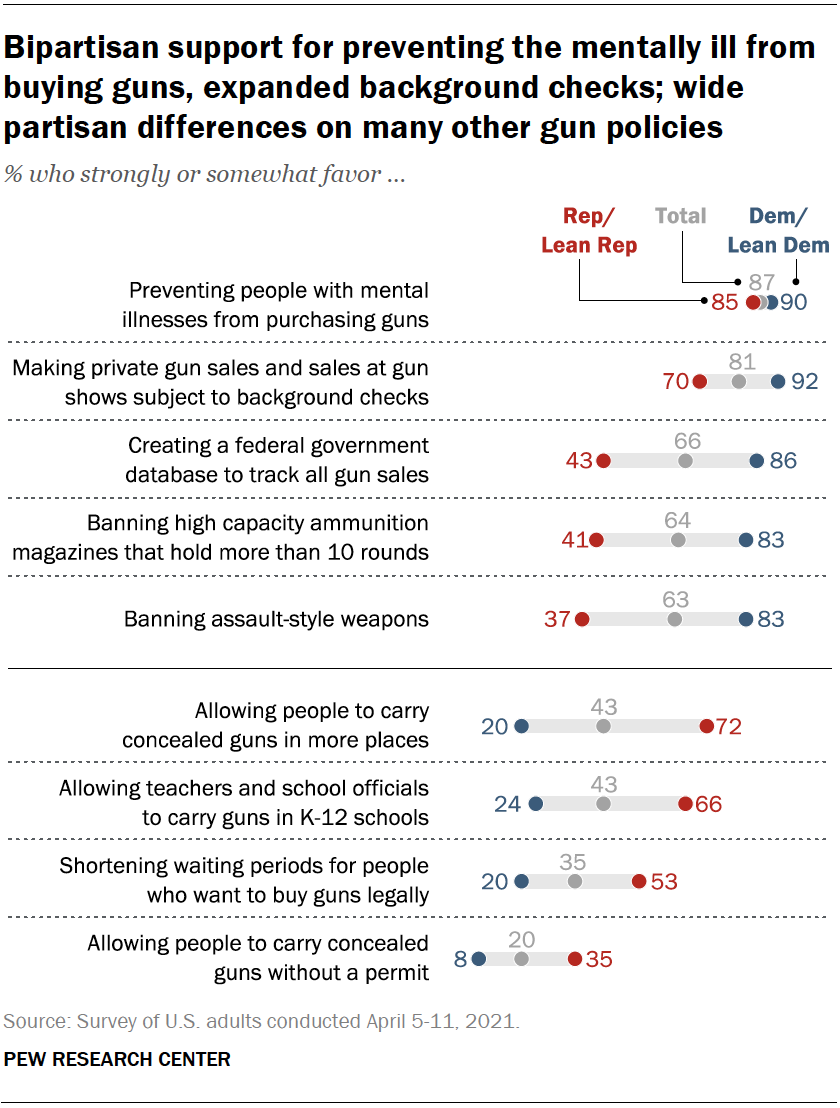
There is broad partisan agreement on some gun policy proposals, only most are politically divisive, the April 2022 survey found. Majorities in both partisan coalitions favor 2 policies that would restrict gun access: preventing those with mental illnesses from purchasing guns (85% of Republicans and 90% of Democrats support this) and subjecting private gun sales and gun show sales to background checks (70% of Republicans, 92% of Democrats). Majorities in both parties also oppose assuasive people to behave concealed firearms without a let.
Other proposals bring out stark partisan rifts. While 80% or more than Democrats favor creating a federal database to runway all gun sales and banning both assault-style weapons and high-chapters ammunition magazines that concur more than 10 rounds, majorities of Republicans oppose these proposals.
Well-nigh Republicans, on the other hand, support allowing people to bear concealed guns in more places (72%) and assuasive teachers and school officials to acquit guns in Thou-12 schools (66%). These proposals are supported by just xx% and 24% of Democrats, respectively.
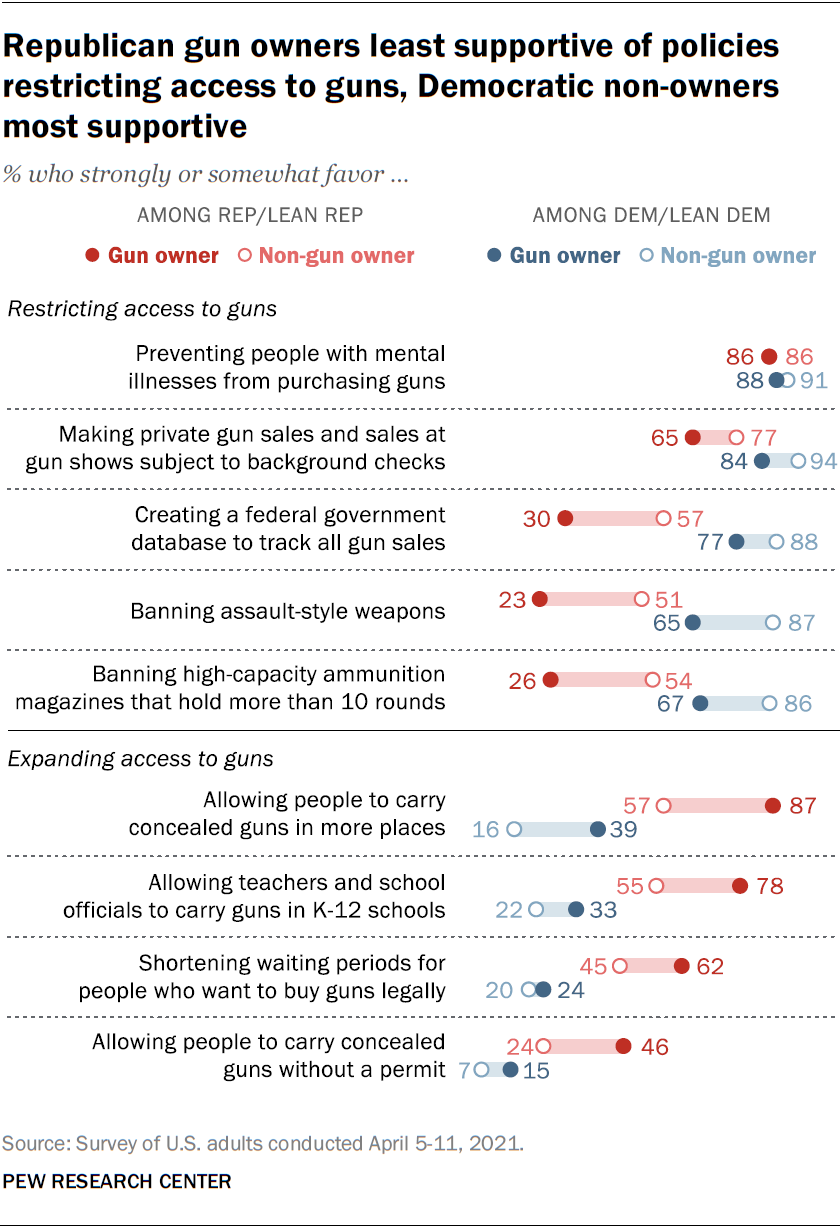
Gun ownership is closely linked with views on gun policies. This is true even amidst gun owners and non-owners within the same political party, co-ordinate to the April 2022 Eye survey.
Among Republicans, gun owners are generally less probable than non-owners to favor policies that restrict admission to guns. Democratic not-gun owners are generally the most probable to favor restrictions.
For example, a majority of Republicans who don't own a gun (57%) say they favor creating a federal authorities database to track all gun sales, while xxx% of Republican gun owners say the same. There are similar-sized gaps among Republicans who own guns and those who do not on banning set on-style weapons and loftier-capacity magazines.
Amidst Democrats, at that place are small gaps on gun policies by gun ownership. For instance, while majorities of Democratic gun owners and non-owners both favor banning assault-fashion weapons and banning high-capacity magazines, Democratic gun owners are about 20 percentage points less likely to say this.
Americans in rural areas typically favor more expansive gun access, while Americans in urban places prefer more restrictive policies, co-ordinate to the April 2022 survey. Fifty-fifty though rural areas tend to be more Republican and urban communities more Democratic, this pattern holds truthful even within each political party. For example, 71% of rural Republicans favor allowing teachers and other school officials to comport guns in K-12 schools, compared with 56% of Republicans living in urban places. Conversely, nigh half of Republicans who live in urban communities (51%) favor bans on set on-mode weapons, compared with 31% of those living in rural areas.
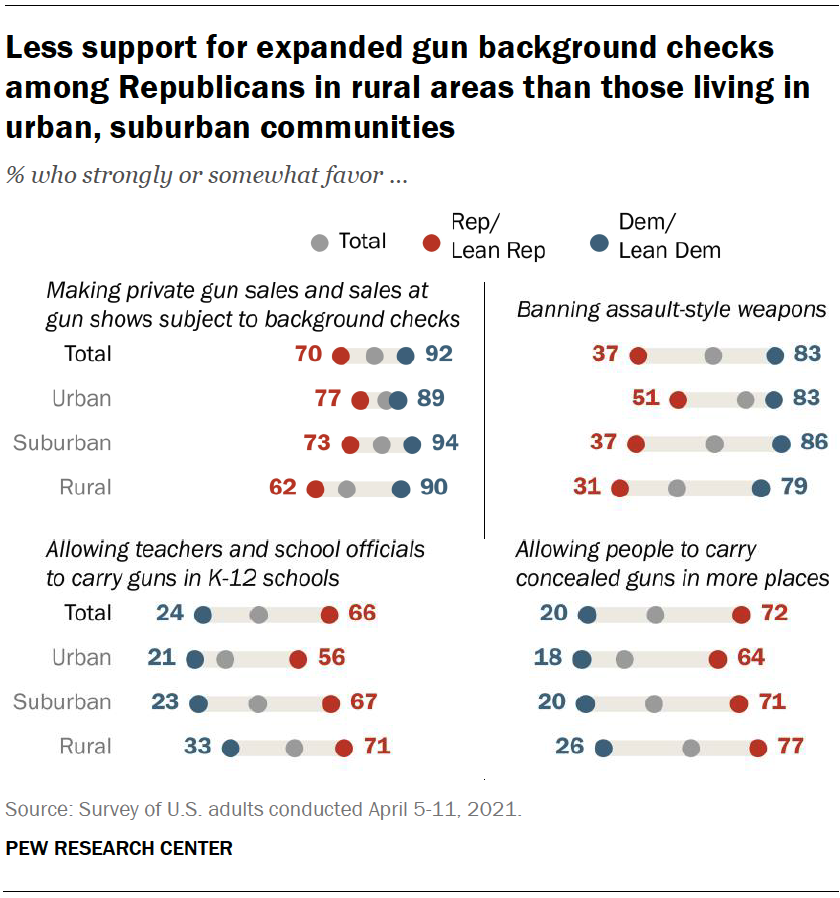
Democrats favor more gun restrictions regardless of where they live, only in that location are still some differences by community blazon. A third of rural Democrats (33%), for instance, support allowing teachers and other schoolhouse officials to carry guns in Thou-12 schools, compared with 21% of those in urban areas.
Note: This is an update of a post originally published on Jan. 5, 2016.
Source: https://www.pewresearch.org/fact-tank/2021/09/13/key-facts-about-americans-and-guns/
0 Response to "Can We Fight Agains the Goverment With Out Guns"
Post a Comment