What Was Baroquerococo Influenced by What Is an Illumination in Art
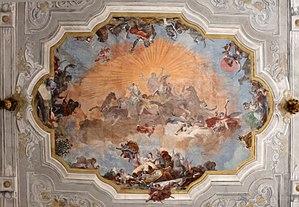
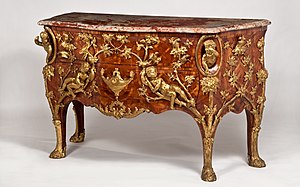
| Ballroom ceiling of the Ca Rezzonico in Venice with illusionistic quadratura painting past Giovanni Battista Crosato (1753); Chest of drawers by Charles Cressent (1730); Kaisersaal of Würzburg Residence by Balthasar Neumann (1749–51) | |
| Years agile | 1730s to 1760s |
|---|---|
| State | France, Italy, Central Europe |

Rococo (, also ), less commonly Roccoco or Late Baroque, is an exceptionally ornamental and theatrical style of compages, art and decoration which combines disproportion, scrolling curves, gilding, white and pastel colors, sculpted molding, and trompe-fifty'œil frescoes to create surprise and the illusion of motility and drama. It is often described every bit the terminal expression of the Baroque motility.[one]
The Rococo manner began in France in the 1730s as a reaction confronting the more than formal and geometric Louis 14 style. Information technology was known as the "way Rocaille", or "Rocaille style".[two] It soon spread to other parts of Europe, especially northern Italian republic, Austria, southern Federal republic of germany, Central Europe and Russian federation.[3] It also came to influence the other arts, peculiarly sculpture, furniture, silverware, glassware, painting, music, and theatre.[4] Although originally a secular way primarily used for interiors of private residences, the Rococo had a spiritual aspect to information technology which led to its widespread employ in church interiors, particularly in Key Europe, Portugal, and S America.[5]
Etymology [edit]

The word rococo was offset used every bit a humorous variation of the word rocaille.[6] [vii] Rocaille was originally a method of decoration, using pebbles, seashells and cement, which was often used to decorate grottoes and fountains since the Renaissance.[viii] [9] In the belatedly 17th and early 18th century rocaille became the term for a kind of decorative motif or ornament that appeared in the tardily Mode Louis XIV, in the form of a seashell interlaced with acanthus leaves. In 1736 the designer and jeweler Jean Mondon published the Premier Livre de forme rocquaille et cartel, a collection of designs for ornaments of furniture and interior ornament. It was the beginning appearance in print of the term "rocaille" to designate the fashion.[10] The carved or molded seashell motif was combined with palm leaves or twisting vines to decorate doorways, piece of furniture, wall panels and other architectural elements.[xi]
The term rococo was start used in print in 1825 to describe ornament which was "out of style and old-fashioned." It was used in 1828 for decoration "which belonged to the style of the 18th century, overloaded with twisting ornaments." In 1829 the writer Stendhal described rococo as "the rocaille fashion of the 18th century."[12]

In the 19th century, the term was used to describe architecture or music which was excessively ornamental.[13] [14] Since the mid-19th century, the term has been accepted by fine art historians. While there is all the same some argue about the historical significance of the style, Rococo is now oft considered equally a distinct menses in the development of European art.
Characteristics [edit]
Rococo features exuberant decoration, with an abundance of curves, counter-curves, undulations and elements modeled on nature. The exteriors of Rococo buildings are often simple, while the interiors are entirely dominated by their decoration. The style was highly theatrical, designed to impress and awe at first sight. Floor plans of churches were frequently complex, featuring interlocking ovals; In palaces, thousand stairways became centrepieces, and offered different points of view of the decoration.[one] The main ornaments of Rococo are: asymmetrical shells, acanthus and other leaves, birds, bouquets of flowers, fruits, musical instruments, angels and Chinoiserie (pagodas, dragons, monkeys, bizarre flowers and Chinese people).[fifteen]
The manner often integrated painting, molded stucco, and wood etching, and quadratura, or illusionist ceiling paintings, which were designed to give the impression that those inbound the room were looking upward at the sky, where cherubs and other figures were gazing downwards at them. Materials used included stucco, either painted or left white; combinations of different colored forest (usually oak, beech or walnut); lacquered wood in the Japanese style, ornamentation of gilded bronze, and marble tops of commodes or tables.[16] The intent was to create an impression of surprise, awe and wonder on first view.[17]
Differences between Baroque and Rococo [edit]
The following are characteristics that Rococo has, and Baroque does not:
- The partial abandonment of symmetry, everything existence composed of svelte lines and curves, similar to Art Nouveau
- The huge quantity of asymmetrical curves and C-shaped volutes
- The broad use of flowers in ornamentation, an example being festoons made of flowers
- Chinese and Japanese motifs (encounter also: chinoiserie and Japonism)
- Warm pastel colours[18] (whitish-yellow, foam-colored, pearl greys, very light dejection)[19]
France [edit]
The Rocaille style, or French Rococo, appeared in Paris during the reign of Louis XV, and flourished betwixt most 1723 and 1759.[20] The manner was used particularly in salons, a new style of room designed to impress and entertain guests. The well-nigh prominent example was the salon of the Princess in Hôtel de Soubise in Paris, designed by Germain Boffrand and Charles-Joseph Natoire (1735–xl). The characteristics of French Rococo included exceptional artistry, especially in the complex frames made for mirrors and paintings, which were sculpted in plaster and ofttimes gilded; and the use of vegetal forms (vines, leaves, flowers) intertwined in complex designs.[21] The article of furniture also featured sinuous curves and vegetal designs. The leading furniture designers and craftsmen in the fashion included Juste-Aurele Meissonier, Charles Cressent, and Nicolas Pineau.[22] [23]
The Rocaille style lasted in France until the mid-18th century, and while it became more than curving and vegetal, it never achieved the extravagant exuberance of the Rococo in Bavaria, Austria and Italian republic. The discoveries of Roman antiquities commencement in 1738 at Herculaneum and especially at Pompeii in 1748 turned French architecture in the direction of the more symmetrical and less flamboyant neo-classicism.
-

Thousand Bedchamber of the Prince, Hotel de Soubise (1735–twoscore)
Italian republic [edit]
Artists in Italian republic, especially Venice, also produced an exuberant rococo style. Venetian commodes imitated the curving lines and carved ornament of the French rocaille, but with a detail Venetian variation; the pieces were painted, oft with landscapes or flowers or scenes from Guardi or other painters, or Chinoiserie, against a blue or green background, matching the colours of the Venetian school of painters whose piece of work decorated the salons. Notable decorative painters included Giovanni Battista Tiepolo, who painted ceilings and murals of both churches and palazzos, and Giovanni Battista Crosato who painted the ballroom ceiling of the Ca Rezzonico in the quadraturo manner, giving the illusion of three dimensions. Tiepelo travelled to Germany with his son during 1752–1754, decorating the ceilings of the Würzburg Residence, one of the major landmarks of the Bavarian rococo. An earlier historic Venetian painter was Giovanni Battista Piazzetta, who painted several notable church ceilings. [24]
The Venetian Rococo as well featured exceptional glassware, particularly Murano glass, often engraved and coloured, which was exported across Europe. Works included multicolour chandeliers and mirrors with extremely ornate frames. [24]
-

Ceiling of church of Santi Giovanni e Paolo in Venice, by Piazzetta (1727)
Southern Frg [edit]
In church construction, especially in the southern German-Austrian region, gigantic spatial creations are sometimes created for practical reasons lonely, which, however, exercise non appear awe-inspiring, only are characterized past a unique fusion of architecture, painting, stucco, etc., often completely eliminating the boundaries between the art genres, and are characterized by a light-filled weightlessness, festive cheerfulness and movement. The Rococo decorative style reached its summit in southern Germany and Republic of austria from the 1730s until the 1770s. There it dominates the church mural to this day and is deeply anchored at that place in popular culture. It was first introduced from France through the publications and works of French architects and decorators, including the sculptor Claude III Audran, the interior designer Gilles-Marie Oppenordt, the architect Germain Boffrand, the sculptor Jean Mondon, and the draftsman and engraver Pierre Lepautre. Their piece of work had an important influence on the German language Rococo style, but does not reach the level of buildings in southern Frg.[25]
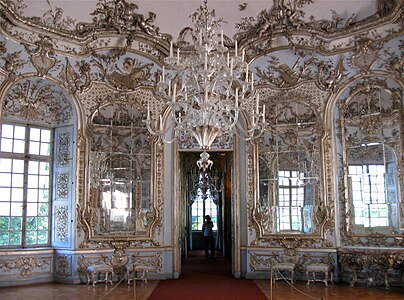
German language architects adapted the Rococo style but made it far more asymmetric and loaded with more than ornate decoration than the French original. The German style was characterized by an explosion of forms that cascaded down the walls. It featured molding formed into curves and counter-curves, twisting and turning patterns, ceilings and walls with no right angles, and stucco leafage which seemed to be creeping up the walls and across the ceiling. The decoration was often golden or silvered to requite information technology contrast with the white or pale pastel walls.[26]
The Belgian-born architect and designer François de Cuvilliés was one of the starting time to create a Rococo building in Germany, with the pavilion of Amalienburg in Munich, (1734-1739), inspired by the pavilions of the Trianon and Marly in France. Information technology was built every bit a hunting society, with a platform on the roof for shooting pheasants. The Hall of Mirrors in the interior, past the painter and stucco sculptor Johann Baptist Zimmermann, was far more exuberant than whatever French Rococo.[27]
Another notable example of the early German Rococo is Würzburg Residence (1737–1744) synthetic for the Prince-Bishop of Würzburg by Balthasar Neumann. Neumann had traveled to Paris and consulted with the French rocaille decorative artists Germain Boffrand and Robert de Cotte. While the outside was in more than sober Baroque manner, the interior, specially the stairways and ceilings, was much lighter and decorative. The Prince-Bishop imported the Italian Rococo painter Giovanni Battista Tiepolo in 1750–53 to create a mural over the top of the iii-level ceremonial stairway.[28] [29] Neumann described the interior of the residence as "a theater of light". The stairway was too the central element in a residence Neumann built at the Augustusburg Palace in Brühl (1743–1748). In that edifice the stairway led the visitors upwards through a stucco fantasy of paintings, sculpture, ironwork and ornamentation, with surprising views at every turn.[28]
In the 1740s and 1750s, a number of notable pilgrimage churches were constructed in Bavaria, with interiors decorated in a distinctive variant of the rococo way. One of the most notable examples is the Wieskirche (1745–1754) designed past Dominikus Zimmermann. Like most of the Bavarian pilgrimage churches, the exterior is very simple, with pastel walls, and little decoration. Entering the church the visitor encounters an astonishing theater of movement and low-cal. It features an oval-shaped sanctuary, and a deambulatory in the same form, filling in the church with light from all sides. The white walls contrasted with columns of bluish and pink stucco in the choir, and the domed ceiling surrounded by plaster angels beneath a dome representing the heavens crowded with colorful Biblical figures. Other notable pilgrimage churches include the Basilica of the Xiv Holy Helpers past Balthasar Neumann (1743–1772).[30] [31]

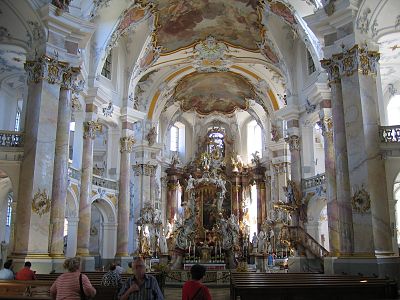

Johann Michael Fischer was the architect of Ottobeuren Abbey (1748–1766), some other Bavarian Rococo landmark. The church building features, similar much of the rococo compages in Germany, a remarkable dissimilarity betwixt the regularity of the facade and the overabundance of decoration in the interior.[28]
U.k. [edit]
In Keen Great britain, rococo was chosen the "French gustatory modality" and had less influence on design and the decorative arts than in continental Europe, although its influence was felt in such areas as silverwork, porcelain, and silks. William Hogarth helped develop a theoretical foundation for Rococo beauty. Though not mentioning rococo by name, he argued in his Analysis of Dazzler (1753) that the undulating lines and Due south-curves prominent in Rococo were the basis for grace and beauty in art or nature (unlike the straight line or the circle in Classicism).[32]
Rococo was slow in arriving in England. Before inbound the Rococo, British furniture for a fourth dimension followed the neoclassical Palladian model under designer William Kent, who designed for Lord Burlington and other important patrons of the arts. Kent travelled to Italy with Lord Burlington between 1712 and 1720, and brought back many models and ideas from Palladio. He designed the furniture for Hampton Court Palace (1732), Lord Burlington's Chiswick House (1729), London, Thomas Coke'due south Holkham Hall, Norfolk, Robert Walpole'south pile at Houghton, for Devonshire Firm in London, and at Rousham.[22]
Mahogany made its advent in England in virtually 1720, and immediately became pop for piece of furniture, along with walnut wood. The Rococo began to brand an advent in England between 1740 and 1750. The article of furniture of Thomas Chippendale was the closest to the Rococo style, In 1754 he published "Gentleman's and Cabinet-makers' directory", a itemize of designs for rococo, chinoiserie and even Gothic furniture, which achieved wide popularity, going through three editions. Unlike French designers, Chippendale did not utilize marquetry or inlays in his piece of furniture. The predominant designer of inlaid furniture were Vile and Cob, the chiffonier-makers for King George III. Another important effigy in British article of furniture was Thomas Johnson, who in 1761, very late in the menstruation, published a itemize of Rococo article of furniture designs. These include furnishings based on rather fantastic Chinese and Indian motifs, including a canopy bed crowned past a Chinese pagoda (now in the Victoria and Albert Museum).[24]
Other notable figures in the British Rococo included the silversmith Charles Friedrich Kandler.
-

Design for Commode and lamp stands by Thomas Chippendale (1753–54)
-

Blueprint for candlesticks in the "Chinese Gustation" past Thomas Johnson (1756)
-

Chippendale chair (1772), Metropolitan Museum
-

Brazier by silversmith Charles Friedrich Kander (1735), Metropolitan Museum
Russia [edit]
The Russian Empress Catherine the Peachy was some other admirer of the Rococo; The Golden Cabinet of the Chinese Palace in the palace complex of Oranienbaum near Petrograd, designed by the Italian Antonio Rinaldi, is an example of the Russian Rococo.
Decline and end [edit]


The art of Boucher and other painters of the period, with its emphasis on decorative mythology and gallantry, soon inspired a reaction, and a demand for more than "noble" themes. While the Rococo connected in Germany and Austria, the French Academy in Rome began to teach the classic mode. This was confirmed by the nomination of De Troy every bit director of the University in 1738, and then in 1751 past Charles-Joseph Natoire.
Madame de Pompadour, the mistress of Louis Fifteen contributed to the decline of the Rococo style. In 1750 she sent her blood brother, Abel-François Poisson de Vandières, on a two-year mission to written report artistic and archeological developments in Italy. He was accompanied by several artists, including the engraver Charles-Nicolas Cochin and the builder Soufflot. They returned to Paris with a passion for classical fine art. Vandiéres became the Marquis of Marigny, and was named director full general of the King's Buildings. He turned official French architecture toward the neoclassical. Cochin became an important art critic; he denounced the petit way of Boucher, and chosen for a 1000 style with a new emphasis on artifact and nobility in the academies of painting and compages.[33]
The beginning of the stop for Rococo came in the early 1760s as figures like Voltaire and Jacques-François Blondel began to vocalism their criticism of the superficiality and degeneracy of the fine art. Blondel decried the "ridiculous jumble of shells, dragons, reeds, palm-trees and plants" in contemporary interiors.[34]
Past 1785, Rococo had passed out of style in France, replaced past the order and seriousness of Neoclassical artists similar Jacques-Louis David. In Germany, belatedly 18th-century Rococo was ridiculed as Zopf und Perücke ("pigtail and periwig"), and this stage is sometimes referred to every bit Zopfstil. Rococo remained pop in sure German provincial states and in Italian republic, until the second phase of neoclassicism, "Empire style", arrived with Napoleonic governments and swept Rococo away.
Furniture and decoration [edit]
The ornamental style chosen rocaille emerged in France between 1710 and 1750, more often than not during the regency and reign of Louis Fifteen; the manner was likewise called Louis Quinze. Its principal characteristics were picturesque detail, curves and counter-curves, asymmetry, and a theatrical exuberance. On the walls of new Paris salons, the twisting and winding designs, commonly fabricated of gilded or painted stucco, wound around the doorways and mirrors like vines. One of the earliest examples was the Hôtel Soubise in Paris (1704–05), with its famous oval salon decorated with paintings by Boucher, and Charles-Joseph Natoire.[35]
The all-time known French furniture designer of the period was Juste-Aurèle Meissonnier (1695–1750), who was also a sculptor, painter. and goldsmith for the royal household. He held the title of official designer to the Chamber and Cabinet of Louis XV. His work is well known today considering of the enormous number of engravings made of his work which popularized the mode throughout Europe. He designed works for the royal families of Poland and Portugal.
Italian republic was some other place where the Rococo flourished, both in its early and later phases. Craftsmen in Rome, Milan and Venice all produced lavishly decorated furniture and decorative items.
-

Chariot of Apollo design for a ceiling of Count Bielinski past Meissonier, Warsaw, Poland (1734)
-

Canapé designed by Meissonnier for Count Bielinski, Warsaw, Poland (1735)
-
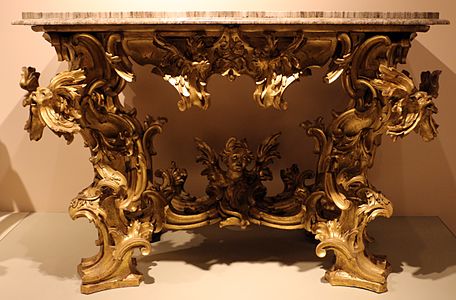
Console tabular array, Rome, Italy (circa 1710)
The sculpted decoration included fleurettes, palmettes, seashells, and foliage, carved in wood. The almost extravagant rocaille forms were constitute in the consoles, tables designed to stand confronting walls. The Commodes, or chests, which had first appeared nether Louis 14, were richly busy with rocaille ornament made of gold bronze. They were fabricated by principal craftsmen including Jean-Pierre Latz and also featured marquetry of unlike-coloured woods, sometimes placed in checkerboard cubic patterns, made with light and dark woods. The period also saw the arrival of Chinoiserie, often in the grade of lacquered and golden commodes, chosen falcon de Chine of Vernis Martin, after the ebenist who introduced the technique to France. Ormolu, or gilded bronze, was used past master craftsmen including Jean-Pierre Latz. Latz fabricated a particularly ornate clock mounted atop a cartonnier for Frederick the Great for his palace in Potsdam. Pieces of imported Chinese porcelain were frequently mounted in ormolu (gilt bronze) rococo settings for display on tables or consoles in salons. Other craftsmen imitated the Japanese fine art of lacquered furniture, and produced commodes with Japanese motifs.[17]
-

-

A Chinese porcelain bowl and 2 fish mounted in gilded bronze, France (1745–49)
British Rococo tended to be more restrained. Thomas Chippendale'south article of furniture designs kept the curves and feel, but stopped short of the French heights of whimsy. The most successful exponent of British Rococo was probably Thomas Johnson, a gifted carver and furniture designer working in London in the mid-18th century.
Painting [edit]
Elements of the Rocaille style appeared in the piece of work of some French painters, including a sense of taste for the picturesque in details; curves and counter-curves; and dissymmetry which replaced the movement of the bizarre with exuberance, though the French rocaille never reached the extravagance of the Germanic rococo.[36] The leading proponent was Antoine Watteau, particularly in Pilgrimage on the Island of Cythera (1717), Louvre, in a genre called Fête Galante depicting scenes of young nobles gathered together to gloat in a pastoral setting. Watteau died in 1721 at the historic period of xxx-7, but his work connected to have influence through the balance of the century. The Pilgrimage to Cythera painting was purchased past Frederick the Groovy of Prussia in 1752 or 1765 to decorate his palace of Charlottenburg in Berlin.[36]
The successor of Watteau and the Féte Galante in decorative painting was François Boucher (1703–1770), the favorite painter of Madame de Pompadour. His piece of work included the sensual Toilette de Venus (1746), which became i of the best known examples of the style. Boucher participated in all of the genres of the time, designing tapestries, models for porcelain sculpture, fix decorations for the Paris opera and opera-comique, and decor for the Fair of Saint-Laurent. [37] Other of import painters of the Fête Galante mode included Nicolas Lancret and Jean-Baptiste Pater. The style particularly influenced François Lemoyne, who painted the lavish decoration of the ceiling of the Salon of Hercules at the Palace of Versailles, completed in 1735.[36] Paintings with fétes gallant and mythological themes by Boucher, Pierre-Charles Trémolières and Charles-Joseph Natoire decorated the famous salon of the Hôtel Soubise in Paris (1735–40).[37] Other Rococo painters include: Jean François de Troy (1679–1752), Jean-Baptiste van Loo (1685–1745), his two sons Louis-Michel van Loo (1707–1771) and Charles-Amédée-Philippe van Loo (1719–1795), his younger brother Charles-André van Loo (1705–1765), and Nicolas Lancret (1690–1743).
In Austria and Southern Germany, Italian painting had the largest effect on the Rococo style. The Venetian painter Giovanni Battista Tiepolo, assisted past his son, Giovanni Domenico Tiepolo, was invited to paint frescoes for the Würzburg Residence (1720–1744). The near prominent painter of Bavarian rococo churches was Johann Baptist Zimmermann, who painted the ceiling of the Wieskirche (1745–1754).


Sculpture [edit]
-

-

The intoxication of vino past Claude Michel (Clodion), terracotta, 1780s-90s
Rococo sculpture was theatrical, colorful and dynamic, giving a sense of motion in every management. Information technology was almost commonly found in the interiors of churches, usually closely integrated with painting and the architecture. Religious sculpture followed the Italian baroque fashion, as exemplified in the theatrical altarpiece of the Karlskirche in Vienna.
Early Rococo or Rocaille sculpture in France sculpture was lighter and offered more motion than the classical style of Louis Xiv. It was encouraged in particular by Madame de Pompadour, mistress of Louis Xv, who commissioned many works for her chateaux and gardens. The sculptor Edmé Bouchardon represented Cupid engaged in etching his darts of beloved from the social club of Hercules. Rococo figures also crowded the later fountains at Versailles, such every bit the Fountain of Neptune by Lambert-Sigisbert Adam and Nicolas-Sebastien Adam (1740). Based on their success at Versailles, they were invited to Prussia past Frederick the Peachy to create fountain sculpture for Sanssouci Palace, Prussia (1740s).[38]
Étienne-Maurice Falconet (1716–1791) was another leading French sculptor during the period. Falconet was most famous for his statue of Peter the Slap-up on horseback in Saint petersburg, but he also created a serial of smaller works for wealthy collectors, which could exist reproduced in a series in terra cotta or cast in bronze. The French sculptors, Jean-Louis Lemoyne, Jean-Baptiste Lemoyne, Louis-Simon Boizot, Michel Clodion, Lambert-Sigisbert Adam and Jean-Baptiste Pigalle all produced sculpture in serial for collectors.[39]
In Italy, Antonio Corradini was among the leading sculptors of the Rococo style. A Venetian, he travelled around Europe, working for Peter the Great in St. petersburg, for the imperial courts in Austria and Naples. He preferred sentimental themes and made several skilled works of women with faces covered by veils, one of which is now in the Louvre.[40]

The most elaborate examples of rococo sculpture were found in Spain, Austria and southern Germany, in the decoration of palaces and churches. The sculpture was closely integrated with the architecture; it was incommunicable to know where 1 stopped and the other began. In the Dais Palace in Vienna, (1721-1722), the vaulted ceiling of the Hall of the Atlantes is held up on the shoulders of muscular figures designed past Johann Lukas von Hildebrandt. The portal of the Palace of the Marquis of Dos Aguas in Valencia (1715-1776) was completely drenched in sculpture carved in marble, from designs by Hipolito Rovira Brocandel.[41]
The El Transparente altar, in the major chapel of Toledo Cathedral is a towering sculpture of polychrome marble and gilded stucco, combined with paintings, statues and symbols. It was fabricated past Narciso Tomé (1721–32), Its blueprint allows light to pass through, and in irresolute light it seems to move.[42]
Porcelain [edit]
A new form of small-scale sculpture appeared, the porcelain figure, or small group of figures, initially replacing sugar sculptures on g dining room tables, only soon popular for placing on mantelpieces and furniture. The number of European factories grew steadily through the century, and some fabricated porcelain that the expanding middle classes could afford. The amount of colourful overglaze decoration used on them likewise increased. They were usually modelled past artists who had trained in sculpture. Mutual subjects included figures from the commedia dell'arte, urban center street vendors, lovers and figures in stylish clothes, and pairs of birds.
Johann Joachim Kändler was the virtually important modeller of Meissen porcelain, the earliest European factory, which remained the nearly of import until about 1760. The Swiss-born High german sculptor Franz Anton Bustelli produced a wide variety of colourful figures for the Nymphenburg Porcelain Manufactory in Bavaria, which were sold throughout Europe. The French sculptor Étienne-Maurice Falconet (1716–1791) followed this example. While likewise making large-calibration works, he became director of the Sevres Porcelain manufactory and produced small works, usually well-nigh dearest and gaiety, for production in series.


Music [edit]
A Rococo period existed in music history, although it is not as well known as the earlier Bizarre and later Classical forms. The Rococo music style itself developed out of bizarre music both in French republic, where the new way was referred to as style galant ("gallant" or "elegant" manner), and in Germany, where it was referred to as empfindsamer Stil ("sensitive style"). It can be characterized every bit light, intimate music with extremely elaborate and refined forms of decoration. Exemplars include Jean Philippe Rameau, Louis-Claude Daquin and François Couperin in France; in Germany, the fashion'due south main proponents were C. P. E. Bach and Johann Christian Bach, 2 sons of J.South. Bach.
In the second half of the 18th century, a reaction against the Rococo style occurred, primarily against its perceived overuse of ornamentation and decoration. Led by Christoph Willibald Gluck, this reaction ushered in the Classical era. By the early on 19th century, Catholic opinion had turned confronting the suitability of the style for ecclesiastical contexts considering it was "in no way conducive to sentiments of devotion".[43]
Russian composer of the Romantic era Pyotr Ilyich Tchaikovsky wrote The Variations on a Rococo Theme, Op. 33, for cello and orchestra in 1877. Although the theme is not Rococo in origin, it is written in Rococo style.
Way [edit]

Sack-dorsum gown and petticoat, 1775-1780 Five&A Museum no. T.180&A-1965
Rococo manner was based on extravagance, elegance, refinement and ornament. Women's fashion of the seventeenth-century was contrasted by the mode of the eighteenth-century, which was ornate and sophisticated, the true style of Rococo.[44] These fashions spread beyond the royal court into the salons and cafés of the dominant bourgeoisie.[45] The exuberant, playful, elegant fashion of ornamentation and pattern that nosotros now know to exist 'Rococo' was then known as le fashion rocaille, le mode moderne, le gout. [46]
A style that appeared in the early on eighteenth-century was the robe volante,[44] a flowing gown, that became popular towards the end of King Louis 14's reign. This gown had the features of a bodice with large pleats flowing down the dorsum to the ground over a rounded petticoat. The colour palette was rich, night fabrics accompanied past elaborate, heavy design features. After the death of Louis XIV the clothing styles began to change. The way took a plough to a lighter, more frivolous style, transitioning from the baroque catamenia to the well-known style of Rococo.[47] The later period was known for their pastel colours, more revealing frocks, and the plethora of frills, ruffles, bows, and lace every bit trims. Shortly after the typical women's Rococo gown was introduced, robe à la Française, [44] a gown with a tight bodice that had a low cutting neckline, usually with a large ribbon bows down the heart front, broad panniers, and was lavishly trimmed in large amounts of lace, ribbon, and flowers.
The Watteau pleats [44] also became more popular, named after the painter Jean-Antoine Watteau, who painted the details of the gowns down to the stitches of lace and other trimmings with immense accurateness. Later, the 'pannier' and 'mantua' became stylish around 1718, they were wide hoops under the dress to extend the hips out sideways and they before long became a staple in formal wear. This gave the Rococo period the iconic apparel of wide hips combined with the large amount of ornament on the garments. Wide panniers were worn for special occasions, and could accomplish up to 16 anxiety (4.viii metres) in diameter,[48] and smaller hoops were worn for the everyday settings. These features originally came from seventeenth-century Spanish fashion, known every bit guardainfante, initially designed to hide the pregnant stomach, then reimagined later as the pannier.[48] 1745 became the Golden Age of the Rococo with the introduction of a more exotic, oriental culture in France called a la turque.[44] This was fabricated popular by Louis 15'due south mistress, Madame Pompadour, who deputed the artist, Charles Andre Van Loo, to paint her as a Turkish sultana.
In the 1760s, a mode of less formal dresses emerged and 1 of these was the polonaise, with inspiration taken from Poland. It was shorter than the French apparel, allowing the underskirt and ankles to be seen, which made information technology easier to move effectually in. Another wearing apparel that came into fashion was the robe a l'anglais, which included elements inspired past the males' fashion; a short jacket, broad lapels and long sleeves.[47] It also had a snug bodice, a total skirt without panniers but yet a little long in the back to grade a pocket-size railroad train, and often some type of lace kerchief worn around the neck. Another piece was the 'redingote', halfway between a cape and an overcoat.
Accessories were also important to all women during this time, as they added to the opulence and the decor of the body to friction match their gowns. At whatever official ceremony ladies were required to cover their hands and arms with gloves if their clothes were sleeveless.[47]
Gallery [edit]
Architecture [edit]

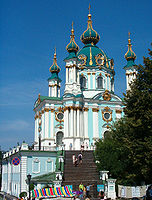
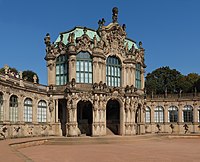


Engravings [edit]
-

Unknown artist. Allegories of astronomy and geography. France (?), ca. 1750s
-

A. Avelin later on Mondon le Fils. Fifty′Heureux moment. 1736
-
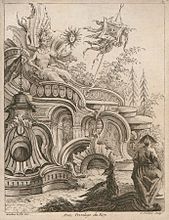
A. Avelin subsequently Mondon le Fils. Chinese God. An engraving from the ouvrage «Quatrieme livre des formes, orneė des rocailles, carteles, figures oyseaux et dragon» 1736
Painting [edit]
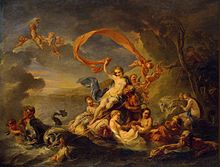


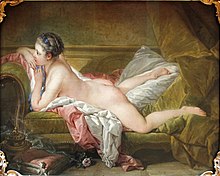

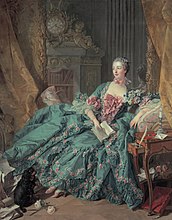


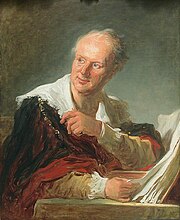

Rococo era painting [edit]

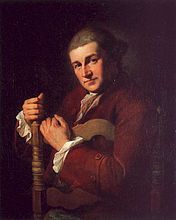

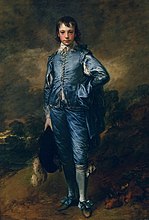

See also [edit]
- Italian Rococo fine art
- Rococo in Portugal
- Rococo in Spain
- Cultural motion
- Gilded woodcarving
- History of painting
- Timeline of Italian artists to 1800
- Illusionistic ceiling painting
- Louis Xv mode
- Louis Xv article of furniture
Notes and citations [edit]
- ^ a b Hopkins 2014, p. 92.
- ^ Ducher 1988, p. 136.
- ^ "What is Rococo?". Victoria and Albert Museum. Retrieved 20 October 2018.
- ^ "Rococo style (blueprint) - Britannica Online Encyclopedia". Britannica.com . Retrieved 24 Apr 2012.
- ^ Gauvin Alexander Bailey, The Spiritual Rococo: Decor and Divinity from the Salons of Paris to the Missions of Patagonia (Farnham: Ashgate, 2014).
- ^ Merriam-Webster Dictionary On-Line
- ^ Monique Wagner, From Gaul to De Gaulle: An Outline of French Civilisation. Peter Lang, 2005, p. 139. ISBN 0-8204-2277-0
- ^ Larousse dictionary on-line
- ^ Marilyn Stokstad, ed. Art History. 4th ed. New Jersey: Prentice Hall, 2005. Print.
- ^ De Morant, Henry, Histoire des arts décoratifs, p. 355
- ^ Renault and Lazé, Les Styles de l'architecture et du mobilier(2006) p. 66
- ^ "Etymology of Rococo" (in French). Ortolong: site of the Centre National des Resources Textuelles et Lexicales. Retrieved 12 January 2019.
- ^ Ancien Regime Rococo Archived 11 April 2018 at the Wayback Machine. Bc.edu. Retrieved on 2011-05-29.
- ^ Rococo – Rococo Art. Huntfor.com. Retrieved on 2011-05-29.
- ^ Graur, Neaga (1970). Stiluri în arta decorativă (in Romanian). Cerces. p. 193 & 194.
- ^ Graur, Neaga (1970). Stiluri în arta decorativă (in Romanian). Cerces. p. 194.
- ^ a b Ducher 1988, p. 144.
- ^ Graur, Neaga (1970). Stiluri în arta decorativă (in Romanaian). Cerces. p. 160 & 163.
- ^ Graur, Neaga (1970). Stiluri în arta decorativă (in Romanian). Cerces. p. 192.
- ^ Lovreglio, Aurélia and Anne, Dictionnaire des Mobiliers et des Objets d'art, Le Robert, Paris, 2006, p. 369
- ^ Hopkins 2014, pp. 92–93.
- ^ a b de Morant 1970, p. 382.
- ^ Kleiner, Fred (2010). Gardner'southward art through the ages: the western perspective. Cengage Learning. pp. 583–584. ISBN978-0-495-57355-5 . Retrieved 21 February 2011.
- ^ a b c de Morant 1970, p. 383.
- ^ De Morant, Henry, Histoire des arts décoratifs (1977), pp. 354–355
- ^ Ducher 1988, pp. 150–153.
- ^ Ducher, Caractéristique des Styles (1988), p. 150
- ^ a b c Prina and Demartini (2006) pp. 222–223
- ^ [ane] Archived 30 October 2018 at the Wayback Machine; [2] Archived 30 October 2018 at the Wayback Car; Field, B.Thousand. (2001). The World's Greatest Architecture: Past and Present. Regency House Publishing Ltd.
- ^ Ducher 1988, p. 152.
- ^ Cabanne 1988, pp. 89–94.
- ^ "The Rococo Influence in British Fine art - dummies". dummies . Retrieved 23 June 2017.
- ^ Cabanne 1988, p. 106.
- ^ "Archived copy". Archived from the original on 17 March 2020. Retrieved viii Apr 2013.
{{cite web}}: CS1 maint: archived copy as championship (link) - ^ Cabanne 1988, p. 102.
- ^ a b c Cabanne 1988, p. 98.
- ^ a b Cabanne 1988, p. 104.
- ^ Duby, Georges and Daval, Jean-Luc, La Sculpture de l'Antiquité au XXe Siècle, (2013) pp. 789-791
- ^ Duby, Georges and Daval, Jean-Luc, La Sculpture de l'Antiquité au XXe Siècle, (2013) p. 819
- ^ Duby, Georges and Daval, Jean-Luc, La Sculpture de l'Antiquité au XXe Siècle, (2013) pp. 781-832
- ^ Duby, Georges and Daval, Jean-Luc, La Sculpture de l'Antiquité au XXe Siècle, (2013) pp. 782-783
- ^ Duby, Georges and Daval, Jean-Luc, La Sculpture de l'Antiquité au XXe Siècle, (2013) pp. 802-803
- ^ Rococo Mode – Catholic Encyclopedia. Newadvent.org (1912-02-01). Retrieved on 2014-02-11.
- ^ a b c d e Fukui, A. & Suoh, T. (2012). Manner: A history from the 18th to the 20th century.
- ^ "Baroque/Rococo 1650-1800". History of Costume.
- ^ Coffin, S. (2008). Rococo: The continuing bend, 1730-2008. New York.
- ^ a b c "Marie Antoinette'southward Style Revolution". National Geographic. November 2016. Retrieved 22 April 2018.
- ^ a b Glasscock, J. "Eighteenth-Century Silhouette and Support". The Metropolitan Museum of Art . Retrieved 22 Apr 2018.
Bibliography [edit]
- de Morant, Henry (1970). Histoire des arts décoratifs. Librarie Hacahette.
- Droguet, Anne (2004). Les Styles Transition et Louis XVI. Les Editions de fifty'Amateur. ISBN2-85917-406-0.
- Cabanne, Perre (1988), L'Art Classique et le Bizarre, Paris: Larousse, ISBN978-2-03-583324-2
- Duby, Georges and Daval, Jean-Luc, La Sculpture de l'Antiquité au XXe Siècle, (French translation from German language), Taschen, (2013), (ISBN 978-3-8365-4483-2)
- Ducher, Robert (1988), Caractéristique des Styles, Paris: Flammarion, ISBNii-08-011539-1
- Fierro, Alfred (1996). Histoire et dictionnaire de Paris. Robert Laffont. ISBN2-221--07862-4.
- Prina, Francesca; Demartini, Elena (2006). Petite encylopédie de l'architecture. Paris: Solar. ISBN2-263-04096-Ten.
- Hopkins, Owen (2014). Les styles en architecture. Dunod. ISBN978-2-10-070689-ane.
- Renault, Christophe (2006), Les Styles de l'architecture et du mobilier, Paris: Gisserot, ISBN978-ii-877-4746-58
- Texier, Simon (2012), Paris- Panorama de fifty'compages de l'Antiquité à nos jours, Paris: Parigramme, ISBN978-ii-84096-667-8
- Dictionnaire Historique de Paris. Le Livre de Poche. 2013. ISBN978-2-253-13140-3.
- Vila, Marie Christine (2006). Paris Musique- Huit Siècles d'histoire. Paris: Parigramme. ISBN978-2-84096-419-three.
- Marilyn Stokstad, ed. Art History. tertiary ed. New Jersey: Prentice Hall, 2005. Impress.
- Bailey, Gauvin Alexander (2014). The Spiritual Rococo: Décor and Divinity from the Salons of Paris to the Missions of Patagonia. Farnham: Ashgate. The Spiritual Rococo: Decor and Divinity from the Salons of Paris to the Missions of Patagonia
Further reading [edit]
- Kimball, Fiske (1980). The Cosmos of the Rococo Decorative Syle. New York: Dover Publications. ISBN0-486-23989-6.
- Arno Schönberger and Halldor Soehner, 1960. The Age of Rococo. Published in the United states of america every bit The Rococo Age: Fine art and Culture of the 18th Century (Originally published in German, 1959).
- Levey, Michael (1980). Painting in Eighteenth-Century Venice . Ithaca: Cornell University Press. ISBN0-8014-1331-1.
- Kelemen, Pál (1967). Baroque and Rococo in Latin America . New York: Dover Publications. ISBN0-486-21698-5.
External links [edit]
 | Wikimedia Commons has media related to Rococo fine art. |
 | Look up rococo in Wiktionary, the complimentary lexicon. |
- All-art.org: Rococo in the "History of Art"
- "Rococo Mode Guide". British Galleries. Victoria and Albert Museum. Retrieved 16 July 2007.
- History of Rococo. Fine art, architecture & luxury History & Civilization Academy of Latgale
- Bergerfoundation.ch: Rococo style examples
- Barock- und Rococo- Architektur, Volume 1, Function 1, 1892(in High german) Kenneth Franzheim 2 Rare Books Room, William R. Jenkins Compages and Art Library, University of Houston Digital Library.
0 Response to "What Was Baroquerococo Influenced by What Is an Illumination in Art"
Post a Comment