what is the name given to 0 degrees latitude what continent is at 20 south and 140 east
Introduction
Comparison of these projections:
| Projection | Type | Key virtues | Comments |
|---|---|---|---|
| Stereographic | azimuthal | conformal | Created before 150 Advertising Best Used in areas over the Poles or for minor scale continental mapping |
| Lambert Conformal Conic | conic | conformal | Created in 1772 Best Used in mid-latitudes – e.m. USA, Europe and Australia |
| Mercator | cylindrical | conformal and true direction | Created in 1569 Best Used in areas around the Equator and for marine navigation |
| Robinson | pseudo-cylindrical | all attributes are distorted to create a 'more pleasant' appearance | Created in the 1963 Best Used in areas effectually the Equator |
| Transverse Mercator | cylindrical | conformal | Created in 1772 Best Used for areas with a due north-due south orientation |
Azimuthal Projection – Stereographic
The oldest known record of this projection is from Ptolemy in virtually 150 Advertisement. However information technology is believed that this projection was well known long before that fourth dimension – probably every bit far back as the 2nd century BC.
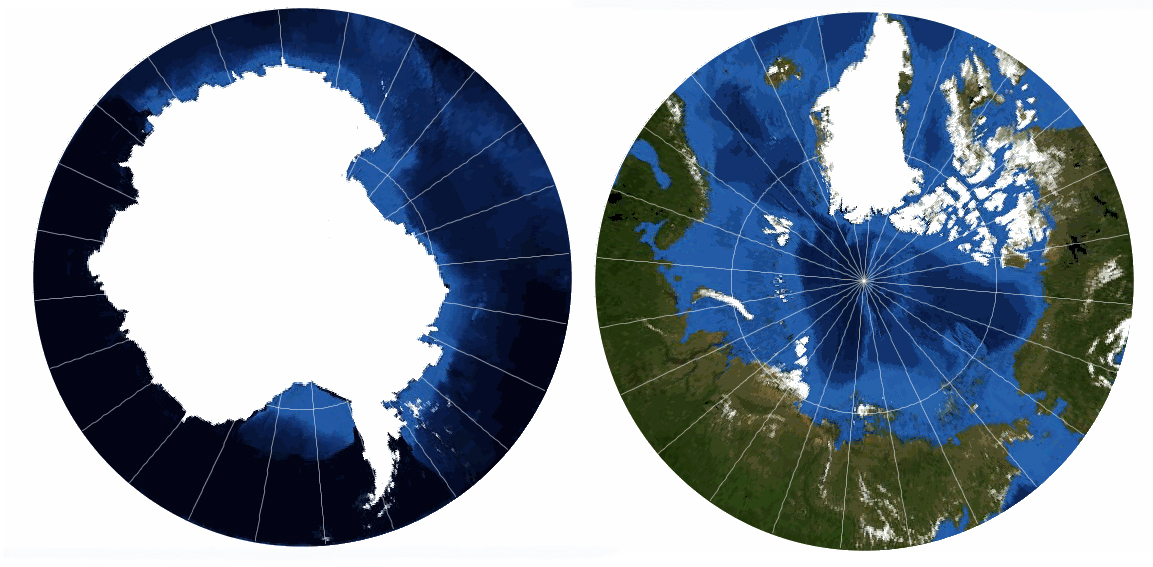
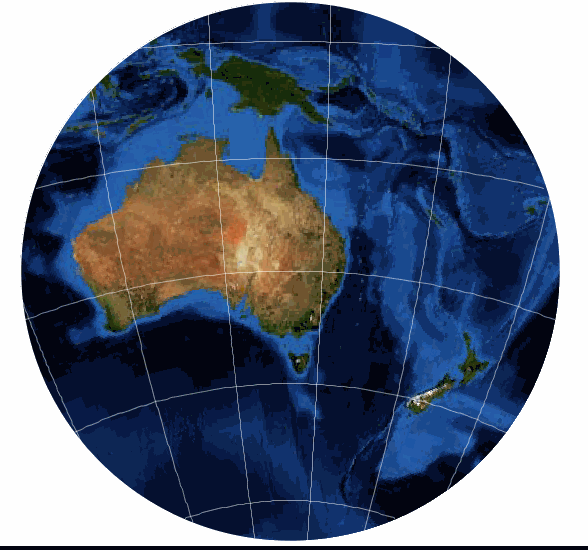
Today, this is probably one of the most widely used Azimuthal projections. It is virtually unremarkably used over Polar areas, but can be used for pocket-size scale maps of continents such as Commonwealth of australia. The slap-up attraction of the projection is that the Earth appears as if viewed class infinite or a globe.
This is a conformal project in that shapes are well preserved over the map, although extreme distortions practice occur towards the edge of the map. Directions are true from the centre of the map (the touch bespeak of our imaginary 'piece of paper'), simply the map is not equal-area.
I interesting feature of the Stereographic project is that any straight line which runs through the middle betoken is a Corking Circle . The advantage of this is that for a place of interest (e.1000. Canberra, the capital letter city of Australia) a map which uses the Stereographic project and is centred on that place of interest true distances tin can be calculated to other places of involvement (eastward.g. Canberra to Sydney; or Canberra to Darwin; or Canberra to Wellington, New Zealand).
Conic Project – Lambert Conformal Conic
Johann Heinrich Lambert was a German ⁄ French mathematician and scientist. His mathematics was considered revolutionary for its time and is still considered important today. In 1772 he released both his Conformal Conic projection and the Transverse Mercator Projection.
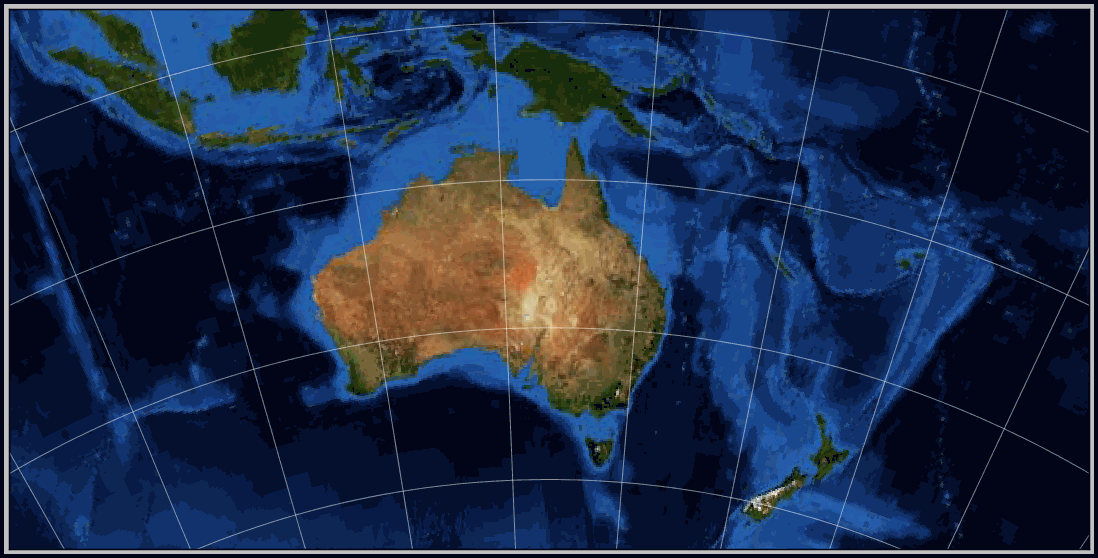
Today the Lambert Conformal Conic projection has become a standard projection for mapping big areas (pocket-sized scale) in the mid-latitudes – such equally The states, Europe and Australia. It has as well get particularly popular with aeronautical charts such every bit the ane:100,000 scale World Aeronautical Charts map series.
This projection commonly used two Standard Parallels (lines of latitudes which are unevenly spaced concentric circles).
The projection is conformal in that shapes are well preserved for a considerable extent well-nigh to the Standard Parallels. For globe maps the shapes are extremely distorted away from Standard Parallels. This is why it is very popular for regional maps in mid-breadth areas (approximately 20° to 60° North and Southward).
Distances are simply true along the Standard Parallels. Across the whole map directions are generally true.
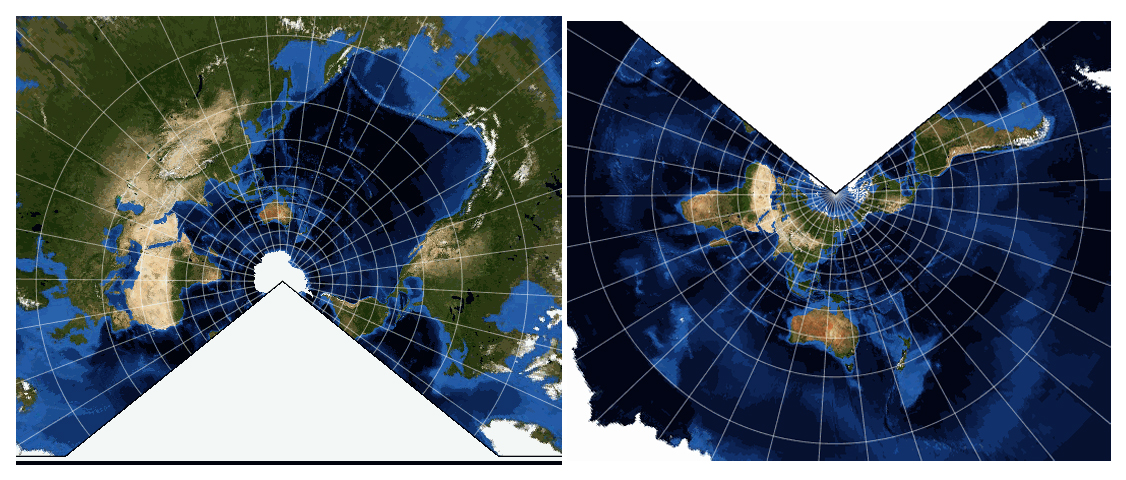
First map has standard Parallels at 30° and lx° South and the second has standard Parallels at thirty° and 60° N.
Cylindrical Projection – Mercator
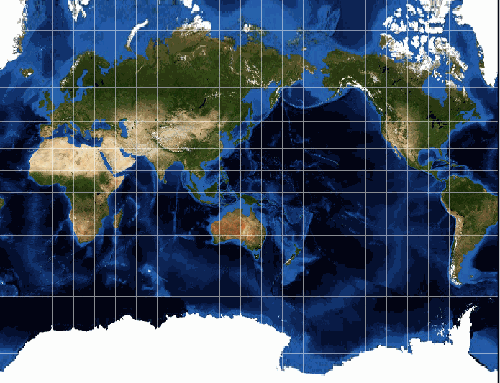
One of the almost famous map projections is the Mercator, created by a Flemish cartographer and geographer, Geradus Mercator in 1569.
It became the standard map projection for nautical purposes considering of its ability to represent lines of constant true management. (Constant true direction means that the straight line connecting any ii points on the map is the same direction that a compass would show.) In an era of sailing ships and navigation based on management only, this was a vitally of import feature of this project.
The Mercator Project e'er has the Equator as its Standard Parallel. Its construction is such that the lines of longitude and latitude are at right angles to each other – this means that a earth map is always a rectangle.
Also, the lines of longitude are evenly spaced apart. But the distance betwixt the lines of latitude increase away from the Equator. This human relationship is what allows the direction between any two points on the map to be constant true direction.
While this human relationship betwixt lines of lines of latitude and longitude correctly maintains direction, it allows for baloney to occur to areas, shapes and distances. Nearest the Equator there is little baloney. Distances along the Equator are e'er correct, only nowhere else on the map. Betwixt nigh 15° north and south the areas and shapes are well preserved. Further out (to about 50° north and due south) the areas and shapes are reasonably well preserved. This is why, for uses other than marine navigation, the Mercator projection is recommended for apply in the Equatorial region merely.
Despite these distortions the Mercator projection is by and large regarded as being a conformal projection. This is because inside pocket-size areas shapes are essentially truthful.
See likewise Transverse Mercator and Universal Transverse Mercator below.
Cylindrical Project – Robinson
In the 1960s Arthur H. Robinson, a Wisconsin geography professor, developed a project which has become much more popular than the Mercator project for world maps. Information technology was developed because mod map makers had become dissatisfied with the distortions inherent in the Mercator projection and they wanted a world project which 'looked' more similar reality.
In its time, the Robinson project replaced the Mercator projection every bit the preferred projection for world maps. Major publishing houses which have used the Robinson projection include Rand McNally and National Geographic.
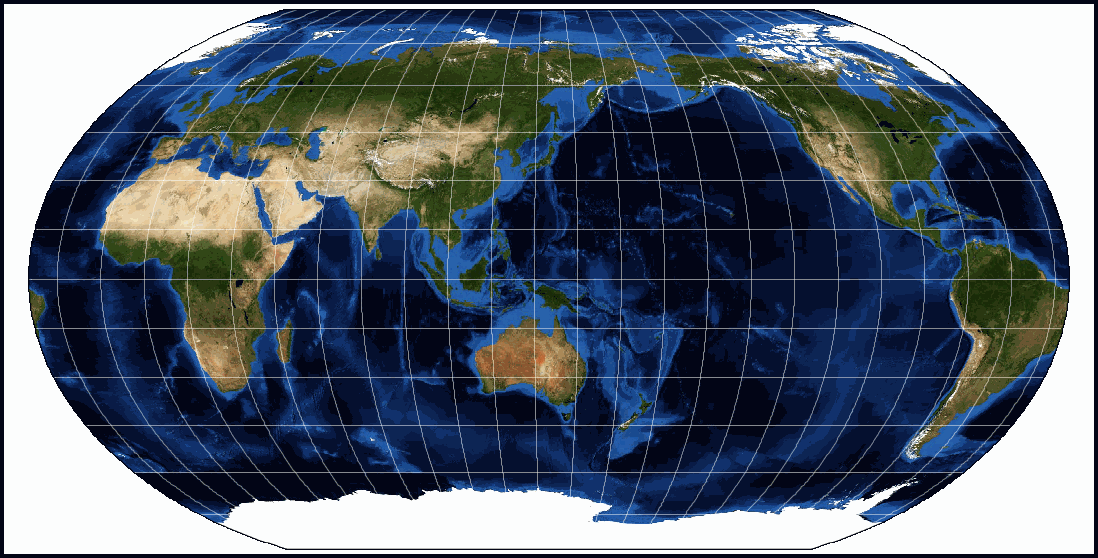
As it is a pseudo-cylindrical projection, the Equator is its Standard Parallel and information technology nonetheless has similar distortion issues to the Mercator project.
Between most 0° and 15° the areas and shapes are well preserved. However, the range of acceptable distortion has been expanded from approximately 15° north and south to approximately 45° north to s. Also, there is less baloney in the Polar regions.
Unlike the Mercator project, the Robinson project has both the lines of altitude and longitude evenly spaced across the map. The other significant difference to the Mercator is that only the line of longitude in the centre of the map is straight (Central Meridian), all others are curved, with the corporeality of bend increasing away from the Central Meridian.
In opting for a more pleasing appearance, the Robinson projection 'traded' off distortions – this project is neither conformal, equal-area, equidistant nor true management.
Cylindrical Projection – Transverse Mercator
Johann Heinrich Lambert was a German ⁄ French mathematician and scientist. His mathematics was considered revolutionary for its time and is still considered important today. In 1772 he released both his Conformal Conic projection and the Transverse Mercator projection.
The Transverse Mercator projection is based on the highly successful Mercator projection. The principal force of the Mercator project is that it is highly accurate near the Equator (the 'touch point' of our imaginary piece of paper – otherwise called the Standard Parallel) and the primary problem with the projection is that distortions increment away from the Equator. This set of virtues and vices meant that the Mercator projection is highly suitable for mapping places which have an east-west orientation near to the Equator just not suitable for mapping places which take are northward-south orientation (eg Due south America or Republic of chile).
Lambert's stroke of genius was to change the way the imaginary slice of paper touched the World… instead of touching the Equator he had information technology touching a line of Longitude (any line of longitude). This touch point is called the Central Meridian of a map. This meant that accurate maps of places with north-southward orientated places could at present exist produced. The map maker only needed to select a Central Meridian which ran through the heart of the map.
A Special Case – Universal Transverse Mercator Organisation (UTM)
It took some other 200 years for the next development in take place for the Mercator projection.
Again, similar Lambert'south revolutionary modify to the mode that the Mercator project was calculated; this development was a change in how the Transverse Mercator projection was used. In 1947 the North Atlantic Treaty Organisation (NATO) adult the Universal Transverse Mercator coordinate organization (more often than not only chosen UTM).
NATO recognised that the Mercator/Transverse Mercator projection was highly authentic along its Standard Parallel/Primal Meridian. Indeed as far equally 5° away from the Standard Parallel ⁄ Central Tiptop there was minimal distortion.
Like the World Aeronautical Charts, the UTM system was able to build on the achievements of the International Map of the World. Also as developing an agreed, international specification the IMW had developed a regular grid organization which covered the unabridged Surface of the Earth. For low to mid-latitudes (0° to sixty° Northward and South) the IMW established a grid system that was vi° of longitude wide and 4° of latitude loftier.
Using this NATO designed a similar regular system for the Earth whereby it was divided into a serial of half-dozen° of longitudinal broad zones. There are a total of 60 longitudinal zones and these are numbered i to sixty – east from longitude 180° . These extend from the Due north Pole to the South Pole. A central meridian is placed in centre of each longitudinal zone. As a result, within a zone nothing is more than 3° from the central meridian and therefore locations, shapes and sizes and directions betwixt all features are very authentic.
Please note that this is not a new ⁄ revised project, but a series of maps using the same projection (Transverse Mercator). This is not commonly appreciated and UTM is often wrongly described as a projection in its own right – information technology is not – it is a projection arrangement.
This is why UTM is regarded equally a Special Example.
The shortcoming in the UTM system is that betwixt these longitude zones directions are not true – this problem is overcome by ensuring that maps using the UTM organization do not encompass more than one zone.
Earth wide, including Commonwealth of australia, this UTM system is used past mapping agencies for local and national, topographic maps.
UTM Zones
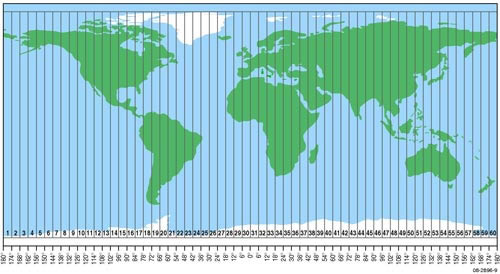
Every bit already noted, the UTM system involves a series of longitudinal zones which are six° wide and numbered 1 to 60 – east from longitude 180°.
However, unlike the International Map of the World (IMW) the UTM system opted to use latitudinal zones which were twice equally wide – i.e. 8° of latitude wide. There are 20 of these and they are numbered A to Z (with O and I not being used) – due north from Antarctica. Similar the IMW system each feature on the Earth is now able to be described based on the UTM grid it is located in. I confusing particular is that these grid cells are variably called a UTM zone.
For instance, in the case of Sydney, Commonwealth of australia, its UTM filigree cell (zone) would exist identified as:
- H – for the latitudinal zone it belongs to
- 56 – for the longitudinal zone information technology belongs to
Add the two together – the UTM grid zone (grid jail cell) which contains Sydney is 56H
UTM Map filigree and the Australian Map Grid
As is explained in the department tiled Explaining Some Jargon – Graticules and Grids there is a significant difference between the two.
- Graticules are lines of Longitude and Latitude. These never course a foursquare or rectangular shape and their shape changes dramatically from the Equator to the Pole – from existence shut to foursquare shaped to being close to triangle shaped.
- Grids are a regularly shaped overlay to a map. They are usually square, but they may be rectangular.
Grids rarely run parallel to lines of Longitude and Latitude.
Besides ease of use, there is another advantage to a grid – on whatever given map it always covers the same amount of the World's surface. This is not true of a graticule arrangement! A 1° x1° block of latitude and longitude near the Equator will e'er cover vastly more than of the World'south surface and a 1° x1° block closer to a Pole. Therefore it is piece of cake to measure distances using a grid – it removes the foibles of distortions inherent in each map projection.
When NATO created the UTM arrangement it recognised this fact and built a filigree system into it. This involves a regular and complex system of letters to identify grid cells. To identify private features or locations distances are beginning measured from the west to the feature and then measured from the south to the feature. The three are combined to requite a precise location – based on the map grid.
Explaining some jargon:
- The Australian Map Grid (AMG) is the map grid which had been adult as office of the UTM organization to best suit Australian needs.
- Northings – these are the horizontal parallel lines of the filigree – i.eastward. they are serial of lines which run from the westward to the eastward (like to lines of latitude – but non the same). Their values increment towards the northward.
- Eastings – these are the vertical parallel lines of the filigree – i.east. they are serial of lines which run from the north to s (similar to lines of longitude – but not the aforementioned). Their values increment towards the eastward.
A Special Case – Geographic (or Plate Carrée)
This is a mathematically unproblematic project. It is also an ancient project (peradventure developed by Marinus of Tyre in 100).
Because of its simplicity information technology was commonly used in the by (before computers allowed for very complex calculations) and it has been adopted every bit the projection of choice for use in estimator mapping applications – notably Geographic Information Systems (GIS) and on web pages. Also, again considering of its simplicity, it is as able to be used with world and regional maps.
Plate Carrée is the French term for flat foursquare. In GIS operations this projection is unremarkably referred to as Geographicals.
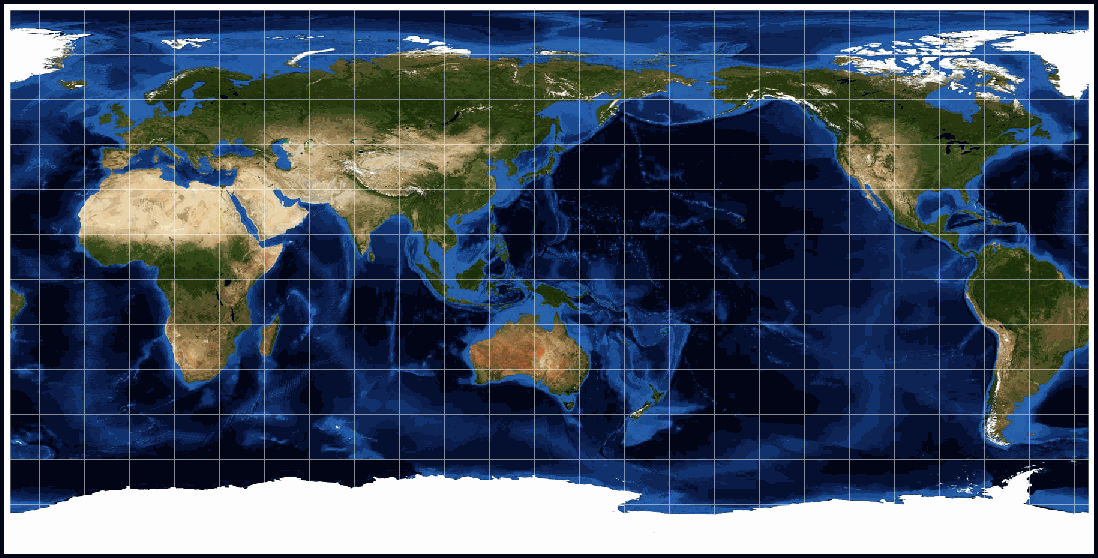
This is a cylindrical projection, with the Equator every bit its Standard Parallel. The difference with this projection is that the latitude and longitude lines intersect to course regularly sized squares. By way of comparing, in the Mercator and Robinson projections they grade irregularly sized rectangles.
While we have described the Geographic or Plate Carrée as a project, in that location is some contend as to whether information technology should exist considered to be a projection. This is because it makes no effort to recoup for distortions due to the transfer of information from the surface of the Globe onto a 'flat piece of paper' (our map).
This is why nosotros are describing the Geographical projection as a Special Case.
Refer to the section on Projections for more information about distortions generated by projections.
Further Reading
- Paul B. Anderson FCCS (USN, Retired) Old Dominion University Geography Department, GIS Teaching Assistant Kingsport – Map Projections
- http://world wide web.csiss.org/map-projections/index.html/
- http://www.galleryofmapprojections.com/images/Aust_Centered_2009.jpg
- http://www.galleryofmapprojections.com/gedymin/gedymin_prof_11x17.pdf
- Carlos A Furuti – Map Projections
- http://www.progonos.com/furuti/MapProj/
- (US) National Atlas Map Projections
- From Spherical Earth to Flat Map
Source: https://www.icsm.gov.au/education/fundamentals-mapping/projections/commonly-used-map-projections
0 Response to "what is the name given to 0 degrees latitude what continent is at 20 south and 140 east"
Post a Comment